

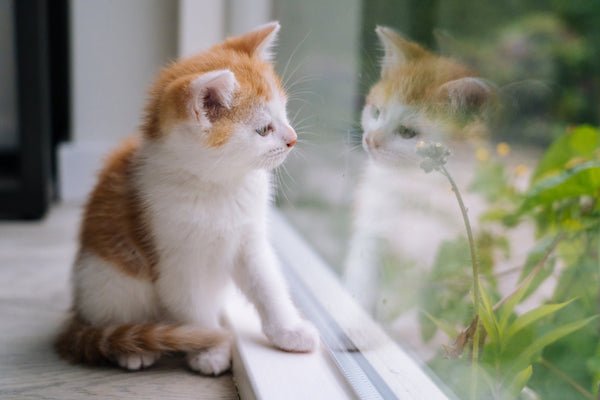
Have you ever noticed your cat staring at the mirror and wondered, “Do they actually recognize themselves?” It’s a curious sight—your furry friend pawing, sniffing, or even ignoring their reflection. But what’s really going on in their mind?
Understanding if cats see themselves as more than just another animal in the glass can reveal surprising insights about their intelligence and behavior. Keep reading, and you’ll discover fascinating facts that might change the way you look at your cat forever.
Credit: a-z-animals.com
Cat Vision And Perception
Cats see the world differently from humans. Their eyes are built to detect movement and see well in low light. Understanding how cats view their surroundings helps explain their reaction to mirrors.
Cats rely more on their sense of smell and hearing than on vision. Their eyes focus on shapes and motions rather than fine details. This affects how they recognize reflections.
How Cats’ Eyes Work
Cats have a high number of rod cells in their eyes. These cells help them see in dim light. They also have a reflective layer called the tapetum lucidum. This layer bounces light back through the retina and improves night vision.
Cats see fewer colors than humans. They mainly detect blues and greens. This limited color vision means they may not notice all features in a reflection.
Cat Brain And Visual Processing
The cat brain processes visual information differently. It focuses on detecting movement and shapes. Cats pay less attention to static objects. A mirror image that does not move like a real cat may seem strange or confusing.
Cats also use other senses to recognize themselves. Smell and touch play key roles. Because mirrors lack these cues, cats may not connect the reflection to themselves.
Why Cats React To Mirrors
- Cats may see the reflection as another cat.
- They might be curious or cautious about the “other” cat.
- Some cats ignore mirrors after a while.
- Others may paw at the glass or try to look behind it.
Their reactions vary based on personality and experience. Mirror images do not have smell or sound, so cats do not fully understand them.
The Mirror Test
The Mirror Test is a well-known experiment used to check if animals recognize themselves in a mirror. It helps scientists understand animal self-awareness. This test shows if an animal knows the reflection is itself, not another animal.
Origins And Purpose
The Mirror Test was created by psychologist Gordon Gallup Jr. in 1970. He wanted to study self-recognition in animals. The test aims to find out if animals have a sense of self. This helps researchers learn about animal intelligence and consciousness.
How It’s Conducted
The test uses a mirror and a mark placed on the animal’s body. The mark is usually on a spot the animal cannot see without a mirror. Researchers watch the animal’s reaction to the mirror reflection.
- If the animal touches or tries to remove the mark, it shows self-recognition.
- If the animal ignores the mark or treats the reflection as another animal, it fails the test.
The Mirror Test has been used on many animals, including primates, dolphins, and birds. Cats often behave differently, making the test results less clear for them.
Cats And The Mirror Test
Cats and the mirror test create a curious topic for pet lovers and scientists. This test checks if animals can recognize themselves in a mirror. It helps measure self-awareness. Cats show unique reactions to their reflections. Their behavior differs from many other animals. Understanding how cats respond sheds light on their intelligence and perception.
Behavioral Observations
Cats often react to mirrors with curiosity or caution. Some may paw or sniff the mirror. Others might ignore it completely. Few cats display signs of recognizing their reflection. They may groom themselves while looking in the mirror. Most cats treat the reflection as another cat. This shows limited self-awareness. They rarely use the mirror to explore their bodies or marks on them.
Repeated exposure to mirrors sometimes changes cats’ behavior. They may lose interest or act more relaxed. This suggests they learn the reflection is not a threat. Still, true self-recognition is rare in cats. Their responses mostly focus on social or territorial instincts.
Comparative Analysis With Other Animals
The mirror test is passed by some animals like great apes, dolphins, and elephants. These species often touch marks placed on their bodies while looking in the mirror. This proves they understand the reflection is themselves. Dogs and cats usually fail this test. They rely more on smell than sight for recognition.
Cats’ mirror behavior contrasts with animals that pass the test. They show less interest in exploring marks on their bodies. Their responses lean toward reacting to another animal. This comparison highlights differences in sensory priorities and cognitive abilities among species.

Credit: www.youtube.com
Scientific Studies On Cat Self-recognition
Scientific studies on cat self-recognition have tried to answer a curious question: Do cats actually know the reflection they see in the mirror is themselves? Researchers have used various tests to observe how cats react to mirrors and whether they show signs of recognizing their own image. Understanding these findings can help you better interpret your cat’s behavior when it encounters a reflective surface.
Key Research Findings
Most studies show that cats do not pass the classic “mirror test,” which is often used to determine self-awareness in animals. This test involves marking an animal with a spot it can only see in the mirror, then watching if the animal tries to investigate or remove the mark on its own body.
- Unlike some primates and dolphins, cats rarely attempt to touch or remove marks seen in the mirror.
- Instead, cats often treat their reflection as another cat, showing behaviors like staring, pawing, or even hissing.
- Some cats quickly lose interest, suggesting they may realize the reflection isn’t a real threat or companion.
Interestingly, a few cats display curiosity that hints at a different kind of self-awareness, like using the mirror to explore parts of their body they normally can’t see. This suggests that while cats might not recognize themselves in the traditional sense, they are still engaging with their reflection in a meaningful way.
Limitations And Challenges
One big challenge in these studies is assuming that cats will respond to mirrors the same way humans or primates do. Cats rely heavily on smell and hearing, so visual cues alone might not be enough for them to identify themselves.
- Tests often ignore the fact that cats prioritize other senses over sight, making mirror recognition less relevant.
- The stress or confusion caused by unfamiliar objects like mirrors can affect a cat’s behavior, leading to misinterpretation of their reactions.
- Individual personality differences in cats mean some may respond differently, making broad conclusions difficult.
Have you noticed your cat reacting differently when looking into a mirror compared to seeing another cat? This could be a sign that your furry friend understands something about the reflection, even if it’s not classic self-recognition.
Alternative Explanations
Cats often react to mirrors in ways that puzzle many owners. They may stare, paw, or even ignore their reflection. These actions raise questions about what cats truly understand. Alternative explanations suggest cats might not recognize themselves but respond to other cues.
Scent And Sound Recognition
Cats rely heavily on scent and sound to identify their world. A mirror lacks these important signals. Without smell or familiar sounds, cats may see the reflection as another animal.
They use their nose and ears more than their eyes. This focus might explain why cats react with curiosity or caution. The reflection does not provide the usual sensory information cats need.
Environmental Influences
The environment shapes how cats react to mirrors. A quiet room with no distractions can make cats more curious. A busy or noisy place might make them ignore the reflection.
Previous experiences also matter. Cats that have seen mirrors before may act differently than those seeing one for the first time. Their environment and past shape their behavior more than self-recognition.
Expert Opinions
Experts offer valuable insights into whether cats recognize themselves in mirrors. Their observations help us understand feline behavior beyond just curiosity or confusion. Let’s look at what animal behaviorists and veterinarians say about this intriguing question.
Views From Animal Behaviorists
Animal behaviorists often observe that cats do not typically recognize themselves in mirrors the way humans do. Instead, many cats treat their reflection like another animal, showing curiosity or sometimes aggression.
One behaviorist shared a story about a cat named Luna, who would paw at the mirror trying to interact with her reflection. This reaction suggests she saw the image as a separate cat, not herself.
Behaviorists explain that cats rely heavily on scent and sound to identify themselves and others. A mirror offers no scent cues, which might explain their inability to connect the reflection with their own identity.
Insights From Veterinarians
Veterinarians point out that cats’ brains process visual information differently from humans. They emphasize that mirror recognition requires a certain level of self-awareness, which cats might not possess.
One vet noted that some cats may ignore mirrors altogether, while others react briefly before losing interest. This shows that the mirror does not hold much significance in their social or environmental awareness.
Considering this, you might wonder: if cats don’t recognize themselves visually, how do they know who they are? The answer lies in their sense of smell and familiar surroundings, which matter more to them than reflections.
Understanding Cat Behavior
Understanding your cat’s behavior can change the way you see those moments when they stare at mirrors. Cats don’t react like humans do, so their actions can seem puzzling. By looking closer at how cats think and respond, you can better interpret their mirror encounters.
Common Misinterpretations
Many people think cats recognize themselves in mirrors, but often, they are just curious or confused. Cats rely heavily on smell and less on sight, so a reflection without a scent can be puzzling to them.
You might see your cat pawing at the mirror or looking behind it. This doesn’t mean they understand it’s their image; they could be trying to find the “other cat” they see. Sometimes, they simply treat the reflection as a new object in their environment.
- They may show signs of curiosity or playfulness.
- Some cats ignore mirrors completely, showing no interest.
- Others might get startled or defensive if they think the reflection is another animal.
Recognizing Intelligence In Cats
Just because cats don’t react like humans in front of mirrors doesn’t mean they lack intelligence. Cats display problem-solving skills and learn from experience in many ways.
Your cat might not recognize itself visually but understands routines and interactions very well. They can remember where you hide treats or how to open doors, which shows sharp mental ability.
Consider how your cat adapts to changes in their environment. This flexibility points to intelligence beyond just visual recognition. What surprising things has your cat figured out that made you admire their cleverness?
Credit: medium.com
Fun Experiments With Cats And Mirrors
Exploring how cats react to mirrors can be both fun and insightful. Cats often show curiosity or confusion when they see their reflection. These moments provide a great chance to learn more about their behavior and self-awareness.
Simple experiments with mirrors can keep your cat entertained and help you observe their natural instincts. These activities also strengthen the bond between you and your pet.
Safe And Engaging Activities
- Place a mirror at your cat’s eye level in a quiet room.
- Use a small mirror first to avoid overwhelming your cat.
- Watch your cat’s reaction without forcing interaction.
- Introduce toys near the mirror to spark interest.
- Keep sessions short to prevent stress or boredom.
Observing Reactions
- Notice if your cat stares, paws, or vocalizes at the reflection.
- Look for signs of curiosity, like sniffing or circling the mirror.
- Some cats may try to play with their reflection.
- Others might show fear or ignore the mirror completely.
- Observe if your cat recognizes the reflection as itself or another cat.
Frequently Asked Questions
Do Cats Recognize Their Reflection In Mirrors?
Cats usually do not recognize themselves in mirrors. They often see their reflection as another cat or object. This behavior shows their limited self-awareness compared to humans and some other animals.
Why Do Cats React To Mirrors Differently?
Cats react to mirrors based on curiosity or confusion. Some may paw or hiss at the reflection, mistaking it for a rival. Others may ignore mirrors entirely as they rely more on scent than sight.
Can Cats Learn To Identify Themselves In Mirrors?
Cats rarely learn to identify themselves in mirrors. Unlike some animals, they lack the cognitive skills for mirror self-recognition. Their natural instincts focus on smells and sounds rather than visual self-awareness.
How Do Cats Use Mirrors In Their Environment?
Cats may use mirrors as part of their environment for play or exploration. They might interact with their reflection out of curiosity but usually do not understand it as themselves. Mirrors can stimulate their mental activity.
Conclusion
Cats often react to mirrors with curiosity or confusion. They may not fully recognize themselves yet. Their behavior shows they see another cat, not their reflection. This suggests self-awareness in cats is still a mystery. Observing your cat’s mirror reactions can be fun.
It helps us learn more about their unique minds. Science continues to study how animals understand themselves. For now, cats remain charming and puzzling creatures. Their mirror moments remind us how special they truly are.
